67 Days of School Embroidery
A Bright, Playful Math Milestone That Catches Eyes—Not Just in Classrooms
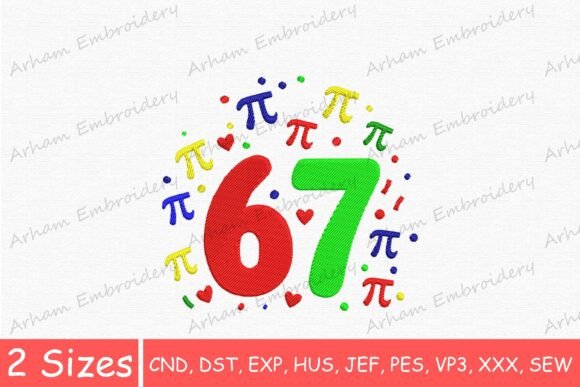
As an embroidery designer who’s prepped over 200 craft fair booths—and shipped thousands of machine embroidery files to Etsy sellers and boutique makers—I’ll say it plainly: 67 Days of School Embroidery lands with cheerful confidence. It’s not minimalist. It’s not rustic or vintage. It’s bold, colorful, and unapologetically joyful—a Pi-themed stitch pattern wrapped around a classroom milestone. That “fun class” energy translates directly to booth appeal: parents pause, teachers smile, and kids point. It reads instantly as Back To School, but with personality—not just calendars and apples.
Where This Design Shines on Craft Fair Products
On a crowded market table, 67 Days of School Embroidery performs strongest where color, clarity, and story intersect:
- Tote bag design: Centered on a medium-weight canvas tote (10"–12" wide), it reads clearly from 6 feet away—especially with high-contrast thread colors against light fabric. Great for teacher gifts or student reward bags.
- Apron embroidery: Positioned above the pocket on a denim or cotton apron, it adds playful professionalism. Teachers love wearing this at open houses or PTA events.
- Tea towel embroidery: Works beautifully on flour-sack or linen-look towels—just keep lettering above 3.5" wide. The Pi motif holds up well next to kitchen prints.
- Embroidered patch: Ideal for iron-on or sew-on application on backpacks, denim jackets, or classroom banners. Its compact shape and balanced layout make it highly scalable for patches.
- Fabric pouch & pillow cover: On a 9"x12" pouch or 16" square pillow, it anchors the piece without overwhelming—especially when paired with coordinating solids or subtle math-themed prints.
It’s less effective on curved surfaces like baseball caps unless resized carefully—the Pi symbol and small numerals can distort. And while it looks festive on mockups, avoid placing it on dark fabric without testing thread contrast first.
What Makes It Sell—And What Requires Caution
This is a story-driven machine embroidery design—and that’s its biggest strength. “67 Days” implies progress, celebration, and shared experience. At a craft fair, that narrative sparks conversation: “Is that for your kid’s class?” “How many days do you have left?” That engagement drives impulse buys.
But practicality matters. Here’s what I check before committing to batch production:
- Stitch density: Described as “colorful” and “Pi themed,” this likely includes layered fills or textured motifs—so inspect for dense areas that could cause puckering on lightweight fabrics or textured tea towels.
- Small lettering: “67 Days” must remain legible at 2.75" wide. If the file includes tiny subtext like “Celebrate a fun class,” that part may vanish on patches or pouches—best reserved for larger applications like tote bags or wall hangings.
- Hoop size & stabilizer needs: A design this detailed often requires mid-size hoops (5x7" or larger) and tear-away + cut-away stabilizer combo—especially for commercial embroidery on stretchy or thick fabric.
- Fabric texture interference: Avoid using it on heavily textured terry cloth or looped towels unless you’ve tested how the Pi symbol and numerals hold definition.
Real-World Booth & Online Performance
In person, 67 Days of School Embroidery stands out in a sea of generic school motifs because it’s specific—not “Back To School,” but *this* classroom’s milestone. That specificity builds trust: buyers see effort, care, and relevance. Paired with a clean handmade product (like a natural linen tea towel or organic cotton tote), it elevates perceived value without raising price points.
For Etsy sellers and digital sellers, this design thrives in listings with strong printable mockups—especially lifestyle shots showing it on real classroom items (a teacher’s apron, a student’s lunchbox pouch). Use tags like “teacher gift embroidery,” “classroom milestone design,” and “Pi Day school embroidery” to capture seasonal search intent.
It’s also highly repeatable for batch production—no gradients, no delicate lacework, no ultra-thin satin stitches. That means faster hooping, fewer thread breaks, and consistent results across 50+ tote bags or 100 patches.
Designer Notes You Can’t Skip
Before cutting fabric or listing your first handmade product, do these six things:
- Test the embroidery file on scrap fabric matching your final product—same weight, same weave, same dye lot.
- Check thread contrast: bright oranges, teals, and purples pop on cream or navy, but fade on black or charcoal unless metallic or high-sheen threads are used.
- Review spacing between elements—especially between “67” and “Days.” Tight kerning won’t read well at smaller sizes.
- Confirm hoop size compatibility with your machine—and whether the design splits cleanly for multi-hooping (critical for large pillow covers).
- Use appropriate stabilizer: cut-away for knits, tear-away for stable wovens, and heavy-duty for structured caps or bags.
- Create at least one real mockup—not just digital. Hold it in natural light. Walk away and look back. Does it still read? Does it feel like a craft fair product worth stopping for?
And always verify commercial licensing before selling finished products. If the digital embroidery file includes terms, honor them. If it doesn’t, reach out to the creator—most reputable designers offer clear commercial use rights for small shop product creators.
Final Thought: This Is More Than a Design—It’s a Moment Made Tangible
67 Days of School Embroidery isn’t just another machine embroidery design. It’s a tiny celebration stitched into fabric—something that turns a plain tote into a keepsake, an apron into a conversation starter, a tea towel into a classroom tradition. For the handmade product maker, it’s low-risk, high-reward: easy to produce, memorable to display, and emotionally resonant to sell. In a season full of predictable apples and pencils, this design brings math, joy, and genuine school spirit—stitched right where it belongs.