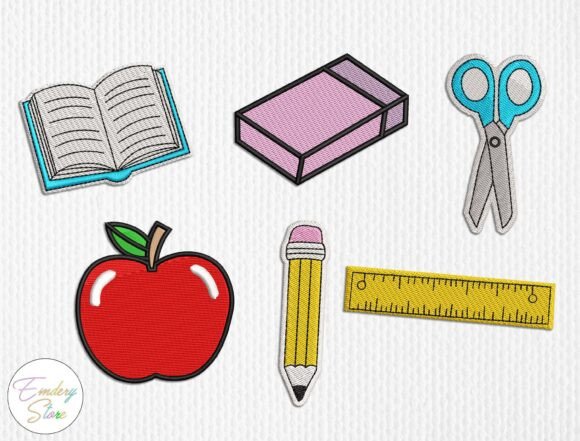
School Supplies Embroidery Patch Set Review
First Glance: Crisp Motifs That Spark Instant Nostalgia
Last week I found myself staring at a blank canvas—literally. A local bookshop had commissioned a small run of handmade tote bags for a back-to-school promotion, and I needed a set of embroidery designs that would feel cheerful, instantly recognizable, and stitch cleanly on medium-weight cotton without fuss. That’s when I loaded the School Supplies Embroidery Patch Set into my software. Right away, the mood landed. Six classic school icons—an open book, eraser, scissors, apple, pencil, and ruler—each with the neat, slightly dense look of a standalone embroidered patch.
There’s something disarmingly honest about a design that doesn’t try too hard. These aren’t overly shaded or filled with complex textures. Instead, they lean into a crisp, almost nostalgic patch aesthetic that reminds me of the iron-on motifs I collected as a kid, only rendered for machine embroidery with what feels like intentional simplicity. The shapes are clear, the edges are defined, and there’s a soft playfulness that will immediately resonate with anyone designing for children, teachers, or stationery lovers. I could already picture a set of these scattered across a pillow cover or lined up neatly along the hem of a kitchen towel.
Still, I’ve learned to never trust a digital preview alone. My mental checklist kicked in: stitch density, registration on dark fabric, small detail preservation, and how these would actually read on a finished product when held at arm’s length.
Stitching Personality on Different Substrates
I ran test stitches on three different materials that mirror what a small shop owner or Etsy seller might actually use: a structured cotton twill tote bag, a fleece-backed sweatshirt blank, and a finely woven cotton muslin destined for a baby onesie front. The School Supplies Embroidery Patch Set performed predictably well on the tote—the smooth, dense weave gave the satin borders a clean edge and let the fill stitches lie flat. The apple’s red and green motifs popped without any puckering, and the book’s open pages, though small, remained legible.
On the sweatshirt, I had to pay closer attention to stabilizer choice. Fleece likes to swallow fine details if you let it. I used a medium-weight cutaway stabilizer and adjusted my presser foot pressure slightly. The result was a soft, almost slightly raised patch effect that felt cozy and intentional—perfect for a customized teacher appreciation sweatshirt or a first-day-of-school top. The ruler’s tiny markings stayed readable, which is always a concern with linear details on textured fabric.
For the baby item, I swapped to a lightweight tear-away stabilizer and used a water-soluble topper to prevent the stitches from sinking into the soft cotton. The eraser design, with its simple pink and silver-gray palette, came out almost too cute for words. That apple would make an adorable bib accent. One design note: because the motifs are compact, they’re naturally suited for infant clothing where larger, heavier embroideries can feel stiff against delicate skin. I’ll be adding this set to my go-to list for custom baby gifts.
Where the Patch Aesthetic Becomes a Selling Point
Because each element is digitized to mimic a patch, the designs have an inbuilt border that looks almost like a self-contained appliqué—but without the extra fabric layer. This framing does two practical things: it visually isolates the motif, making it pop on busy or dark backgrounds, and it reduces the risk of fraying or distortion around the edges when laundered. I tested a dark heather gray t-shirt with the pencil motif in bright yellow and pale blue, and the contrast held beautifully. No bleed-through from the fabric, and the piece didn’t look lost. For anyone selling at craft fairs or on Etsy, that kind of instant brand recognition from a distance can bump a product from “nice” to “must-have.”
Conversely, I’d be careful placing these designs on extremely thin, drapey fabrics like rayon or slub jersey without a sturdy backing. The circle or oval outlines could pull slightly if hooping isn’t dead-on. If you’re planning a flowy summer dress or a lightweight scarf, do a full test run first. The designs are insurance against beginners’ mistakes on stable surfaces, but they still demand respect on tricky grounds.
Small-Size Versatility—But Mind Your Hoop
One of the most practical questions I get from other craft business owners is, “Will this fit my 4×4 hoop?” The short answer: you need to check the finished dimensions of each design in the embroidery file before purchasing. While a single eraser or pencil likely squeezes into a small hoop, the open book or ruler might require a larger field, especially if they’ve been designed as a cohesive patch with a solid border. Nothing disrupts a production day like discovering a design is too wide by two millimeters. Measure twice, stitch once.
These designs are prime candidates for clustered layouts. I often place the apple on the chest of a toddler tee, then add a matching ruler or scissors on the sleeve or back yolk for a coordinated set. Because they share a visual language—same stitch style, similar density, consistent fringed-patch frame—they mix without creating chaos. That’s pure gold for small shops that offer personalized bundles. A library tote with the open book and the apple? A teacher’s apron with the pencil and ruler? The combination storytelling practically writes itself.
Thread Palette and Brand Consistency
I always check how a design translates when I deviate from the recommended thread colors. The School Supplies Embroidery Patch Set doesn’t ship with specific hex codes; what I saw was a clean, well-mapped design that uses standard embroidery palette assumptions: bright red for the apple, soft pink for the eraser, silver for scissors blades, yellow for the pencil barrel, a warm brown or grey for the ruler. These are low-risk choices that almost any thread brand can match. But if you’re building a boutique brand with a signature muted or vintage palette, test a version with ecru, oatmeal, and dusty teal instead of primary colors. I did a mockup of the book in bone white and sepia, and suddenly it felt like a heritage library patch. The design’s structure is strong enough to survive a style remix—a quality I actively look for when recommending assets to other designers.
If you plan to photograph your finished products for an Etsy shop or Instagram, the patch outline gives a crisp silhouette that crops well in mockups. Even in black-and-white product previews, you can see that the satin stitch definition holds its shape. That matters when you’re selling a digital embroidery file as part of a printable mockup pack or using the stitched item in a lifestyle shot. The set doesn’t just stitch well; it photographs like a product feature, not an afterthought.
When to Use (and When to Step Back)
After stitching half a dozen items, here’s my honest field assessment: the School Supplies Embroidery Patch Set thrives on medium-weight cottons, canvas, denim, and tightly woven linens. It’s ideal for:
- Custom tote bag designs for teacher gifts or back-to-school markets
- Pocket-sized patches on kids’ jeans or jackets
- Embroidered accents on pencil cases, book bags, and fabric binder covers
- Kitchen towel embellishments for a playful, school-themed home decor line
- Layered accents on larger, blank sweatshirt fronts
- Holiday gifts—think an apple ornament or a stocking stuffer mini-patch
- Commercial embroidery runs for educational institutions or bookshops
I’d be more cautious on:
- Ultra-stretchy athletic wear or high-spandex blends without precise hooping setup
- Curved surfaces like a narrow cap bill where the patch border may not follow the contour naturally
- Very dark, napped fabrics like black fleece if the design includes tiny inner details that could merge without a high-contrast thread or a solvy topper
- Items that need industrial-strength daily washing—patch-style satin borders can eventually show friction wear if the density is too high. Test in a real laundry cycle before committing to a full batch.
Practical Designer Notes Before You Commit
I never recommend using any embroidery file directly on a client’s expensive garment without first stitching a sample. The School Supplies Embroidery Patch Set is no exception. Here are the steps I’d follow before adding it to a production queue:
- Check the license. Confirm whether the seller permits commercial use on finished products and whether a separate extended license is required for selling digitized goods. Don’t assume; ask.
- Test on scrap fabric that matches your final product. Use the same stabilizer, thread brand, and hooping method you’ll rely on for real orders. I keep a stack of canvas scraps and cotton twill swatches just for this.
- Evaluate stitch density in small corners. The scissors blades or the ruler’s end marks can become needle-punched grave markers if the density is too aggressive. If your test piece comes out stiff or almost hard, consider lowering your machine’s tension slightly or using a softer stabilizer.
- Play with thread color swaps. Stitch a light-on-dark version and a dark-on-light version. Some motifs—like the eraser with its tiny inner details—need enough color contrast to remain distinct, not blur into a pastel puddle.
- Check the finished dimensions against your hoop size. If the design file doesn’t include a size chart, use your embroidery software to measure before you load it onto the machine.
- Think in multiples. This set is designed to be a bundle, so consider selling coordinated sets of patches or creating a “build your own” product option on your website. Customers love seeing a complete story on a tote bag or pillow.
Where the Set Holds Long-Term Value for Your Business
From a design asset perspective, a well-digitized patch set like this can serve your catalog year-round. It isn’t just a back-to-school seasonal piece; it works for teacher appreciation week, reading nook decor, baby shower gifts with a bookish theme, graduation keepsakes, or anytime someone wants a clean, handcrafted nod to learning. I’ve already stitched the open book on a fabric bookmark and the apple on a small linen sachet—both ended up as gift-with-purchase items in my own shop. The emotional connection is immediate because the visual language is universally understood.
When I consider what makes a embroidery design worth reusing across dozens of projects, I look for visual clarity, reliable stitch-out, and the flexibility to adapt to different fabrics and palettes. The School Supplies Embroidery Patch Set clears that bar. It won’t be the star of an elaborate heirloom quilt, but it will become the dependable workhorse behind a cohesive product line—the kind that keeps customers adding matching pieces to their cart because each motif makes the next one feel like a natural addition. And that, for a craft business, is worth far more than a single exquisite standalone design.
Stitch It, Sell It, Gift It—Just Test It First
After running a dozen test pieces and photographing the results, I’m comfortable saying this is a smart pickup for anyone building an embroidery-centric handmade product line, from Etsy sellers to boutique apparel decorators. The designs are evenly digitized, the patch aesthetic adds perceived value (people love a motif that looks like a sew-on badge), and the school theme is evergreen enough to avoid feeling dated after one season. Just remember: small details demand careful stabilizing, and the first sample is always your cheapest insurance policy. Grab a scrap, hoop it up, and see for yourself how those tiny scissor blades and that crisp apple shape turn into something tactile and memorable.