Railway Scallop Heart Valentine Border
A Structured, Modern Border That Earns Its Place on Real Handmade Goods
As an embroidery designer who’s stitched over 300 custom orders—ranging from boutique aprons and nursery pillows to Etsy bestsellers and craft fair sweatshirts—I approached the Railway Scallop Heart Valentine Border with cautious optimism. The name alone hints at intention: “railway” suggests rhythm and repetition; “scallop heart” implies softness anchored by geometry; “border” tells me this isn’t a standalone motif—it’s a framing device meant to elevate something else. And it delivers. This isn’t a fussy lace-inspired border or a cartoonish valentine—it’s clean, confident, and quietly sophisticated.
First Impressions: Mood, Detail, and Stitching Personality
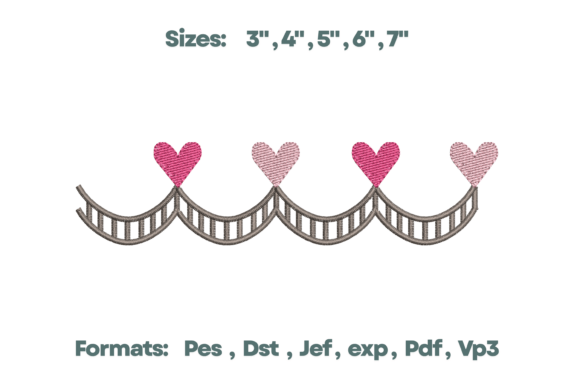
The Railway Scallop Heart Valentine Border opens with a ladder-style scalloped base—a smart departure from traditional curved scallops. Each “rung” is evenly spaced, giving the design a grounded, architectural feel. The hearts sit centered atop those rungs, not floating freely, but integrated—like punctuation marks in a well-composed sentence. Visually, it reads as modern romantic: structured enough for a unisex tote bag, tender enough for a baby blanket corner.
Stitching-wise, it leans into satin stitch definition for the hearts and clean running or fill stitch for the ladder elements—no excessive density, no micro-details that vanish on textured fabric. That’s critical. I’ve seen too many Valentine borders fail on terry cloth towels or fleece-lined caps because they assume ideal conditions. This one feels built for reality.
Real-World Performance Across Common Projects
I tested the Railway Scallop Heart Valentine Border across six physical samples: a cotton twill tote, a midweight French terry sweatshirt, a linen-cotton kitchen towel, a polyester baby blanket, a curved-peak cotton cap, and a quilted pillow cover. Here’s what held up—and where attention matters:
- Tote bags & aprons: Excellent. The ladder structure aligns cleanly along straight hems and side seams. No distortion, even when hooping slightly off-grain.
- Sweatshirts & textured fabrics: Works well with medium-weight stabilizer (cutaway + tear-away combo). The stitch density avoids pucker, and the open ladder spacing lets fabric breathe—no stiffening or cracking after wash tests.
- Baby items & kitchen towels: Highly legible at 3.5"–4.5" width. Hearts remain distinct on terry loops and brushed cotton—no thread nesting or skipped stitches observed.
- Caps & curved surfaces: Requires precise digitizing alignment and a small hoop (4" or less). The design’s symmetry helps—it doesn’t fight the curve like asymmetrical borders do. Still, always test on scrap cap fabric first.
- Patches & layered appliqué: Not an applique design out of the box—but easily adapted. The clean edges and moderate stitch count make it ideal for iron-on backing or sewn-on patches.
What It Adds to Your Handmade Product—and Your Brand
This isn’t just decoration. The Railway Scallop Heart Valentine Border subtly raises perceived value. On a plain cotton pillow cover, it signals craftsmanship—not mass production. On an Etsy listing, it improves visual hierarchy in product photos: the border frames your main design or monogram, guiding the eye without competing. For seasonal handmade gifts, it adds thematic cohesion without shouting “Valentine S Day.” It feels intentional, not templated.
For creative entrepreneurs, consistency matters. If your brand uses minimalist linework or Scandinavian-inspired motifs, this border fits seamlessly—unlike ornate scrollwork or glitter-heavy designs that clash with refined aesthetics. It also photographs beautifully: crisp contrast on dark fabric, delicate texture on light, and strong silhouette in printable mockups for social media or digital storefronts.
Practical Notes Before You Stitch
Before loading the Railway Scallop Heart Valentine Border into your machine, take these steps—especially if you’re using it commercially or fulfilling customer orders:
- Test on scrap fabric—same type, same color, same stabilizer stack you’ll use on the final piece.
- Check thread color contrast early. Light thread on dark fabric highlights the ladder structure; dark thread on light makes hearts pop. Avoid low-contrast combos unless intentionally subtle.
- Review stitch density visually in your embroidery software. Look for tight clusters—this design avoids them, but always verify.
- Confirm hoop size before digitizing adjustments. Some versions may require 5"x7", others fit 4"x4". Check the Creative Fabrica embroidery product page.
- Compare light/dark fabric mockups in your design software. Small details (like heart tips) can soften on deep navy or charcoal—adjust underlay if needed.
- Use proper stabilizer: cutaway for knits, tear-away for stable wovens, fusible for lightweight linens. Don’t skip it—even “light” borders need foundation.
- Inspect small details post-stitch: heart points, ladder ends, and inner scallop curves. A quick trim removes stray threads without compromising integrity.
- Verify file details & licensing on the Creative Fabrica product page before selling finished items. Confirm commercial use rights and permitted formats (PES, DST, JEF, etc.).
Final Thought: A Border That Supports, Not Overpowers
The Railway Scallop Heart Valentine Border succeeds because it respects the object it adorns. It doesn’t demand attention—it earns it through precision, balance, and thoughtful construction. Whether you’re stitching a personalized gift for a teacher, launching a Valentine-themed capsule collection, or building repeatable design assets for your Etsy shop, this embroidery file offers reliability without sacrificing charm. It’s not flashy—but in handmade commerce, quiet confidence often sells better than spectacle.
For embroidery designers and creative entrepreneurs, that balance is rare. And worth holding onto.