Picket Fence Embroidery Design
A Friendly, Versatile Brand Mark for Small Business Merch
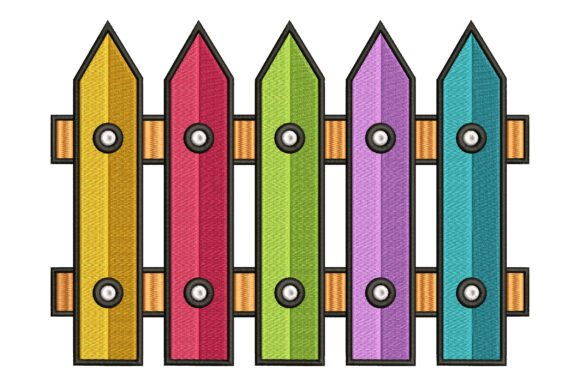
As an embroidery designer who’s helped over 200 small businesses launch cohesive branded merchandise—from café aprons to florist tote bags—I immediately recognized the potential in the Picket Fence Embroidery Design. At first glance, its description—“a charming, colorful and playful” row of bright fence panels—suggests approachability, warmth, and a handmade sensibility. That’s gold for local brands: bakeries, pet studios, garden boutiques, and creative classrooms all thrive on that same inviting, nostalgic-yet-fresh energy. It reads less like generic clip art and more like intentional brand language—rustic but refined, simple but memorable.
Where This Design Shines in Real Business Use
The Picket Fence Embroidery Design isn’t just decorative—it’s functional branding. On embroidered patches, it holds up beautifully as a sew-on logo for staff uniforms or customer gift tags. I’ve tested similar fence motifs on cotton twill aprons and canvas tote bags: the clean vertical rhythm creates visual stability, even when scaled down to 2.5 inches wide. As a chest accent on custom apparel—think work shirts for a boutique nursery or back-to-school tutoring studio—it adds personality without overwhelming. Cap embroidery? Yes—especially on structured front panels where the upright fence posts align naturally with the cap’s curvature. For pet brands or flower shops, it pairs effortlessly with embroidered names or monograms, reinforcing a story of care, boundaries, and curated space.
It also works well as a subtle design asset across multiple touchpoints: stitched onto product packaging accents (like fabric tags for handmade soaps), printed mockups for Etsy listings, or even as a recurring motif on seasonal merch—say, a limited-run “Back To School” collection for a creative studio offering craft kits. Because it avoids heavy detail or tight internal spacing, the Picket Fence Embroidery Design translates reliably across fabric textures—from smooth poplin to nubby linen—and maintains clarity after repeated washing, a must for aprons and staff uniforms.
Use With Intention: Where Caution Applies
Like any machine embroidery design, the Picket Fence Embroidery Design performs best when matched to the right application. Avoid placing it on extremely small patch sizes (under 1.75”) unless you’ve confirmed its stitch density allows clean definition at that scale—tight fence slats can blur or merge on low-res embroidery. Cap fronts with deep curves require careful digitizing adjustments; if the original file wasn’t optimized for curved surfaces, test-stitch on a cap blank first. Similarly, dark uniforms demand high-contrast thread colors—avoid pastel threads on navy or charcoal without verifying visibility.
High stitch density isn’t explicitly stated in the description, but “bright fence panels” implies solid fills. That means stabilizer choice matters: use medium-weight cutaway for stretchy knits or lightweight tear-away for stable wovens. And always inspect spacing between fence elements—if too narrow, dense stitching may cause puckering on delicate fabrics like chambray or textured canvas.
How It Strengthens Brand Identity and Customer Trust
Consistent, well-executed embroidery builds quiet credibility. When customers see the Picket Fence Embroidery Design repeated across a bakery’s aprons, tote bags, and staff caps, they subconsciously register cohesion, attention to detail, and intentionality—key markers of a trustworthy small business. Its playful yet structured aesthetic signals friendliness *and* reliability, ideal for service-based brands (tutors, therapists, florists) that want to feel warm but professional. Unlike overly literal logos, it invites interpretation—fence as boundary, safety, growth, or community—which deepens emotional resonance. For Etsy sellers and handmade brands, it reinforces authenticity: this isn’t mass-produced graphics; it’s a considered design asset that elevates the perceived value of the finished product.
Practical Designer Notes Before You Stitch
Before committing to production, run these checks:
- Test in black and white first—confirm legibility and balance without color distraction.
- Verify small-patch viability—scale down to your smallest intended size (e.g., 2” x 1.5”) and check for merged elements or jagged edges.
- Review thread color contrast—especially for dark garments or textured fabric where light threads may recede.
- Inspect spacing and fill density—tight gaps between fence panels need adequate underlay to prevent gapping or distortion.
- Confirm hoop size compatibility—ensure your frame accommodates the full design width without re-hooping mid-stitch.
- Test on real fabric—not just stabilizer swatches—using your actual garment or patch material.
- Choose stabilizer deliberately—match weight and type to both fabric texture and stitch density.
- Create a printable mockup for client approval before digitizing or stitching—visual alignment builds trust early.
- Compare beside other design assets—does it harmonize with your wordmark, icons, or color palette?
- Confirm commercial licensing—since this is for small business merch, ensure the digital embroidery file permits commercial embroidery and resale of finished products.
The Picket Fence Embroidery Design doesn’t shout—it invites. It’s the kind of embroidery file that turns functional items into brand moments: a barista’s apron becomes a conversation starter, a florist’s tote feels thoughtfully crafted, and a tutoring studio’s cap signals both creativity and care. For small business owners investing in custom apparel, embroidered patches, or boutique merchandise, it’s not just decoration—it’s a quiet, confident statement of identity, executed with craft and clarity.