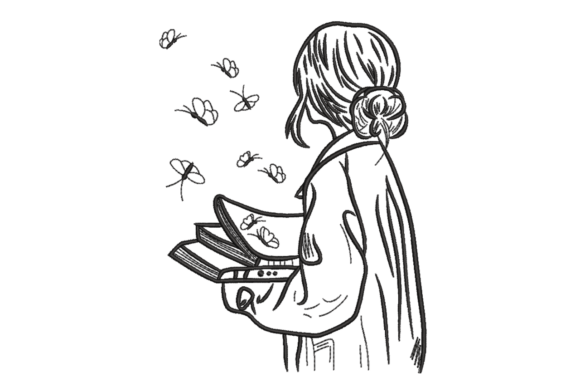
Bookish Girl Butterflies
A Practical Embroidery Designer’s Review for Small Business Merchandise
As an embroidery designer who’s digitized and stitched thousands of designs for small businesses—from indie bookshops and floral studios to bakeries and pet boutiques—I approach every new machine embroidery design with two questions: Will it translate cleanly across real-world fabrics and applications? and Does it strengthen brand identity—not just decorate? That’s why I took a close look at Bookish Girl Butterflies before recommending it for client projects. The title alone signals warmth, intelligence, and gentle whimsy—ideal for brands that lean into storytelling, literacy, creativity, or mindful living. It doesn’t scream “trendy” or “corporate.” Instead, it feels quietly confident: handmade but polished, playful but professional.
Where Bookish Girl Butterflies Shines in Real Business Use
Bookish Girl Butterflies works exceptionally well as an embroidered patch—especially for boutique merchandise, staff aprons, tote bags, and branded caps. Its balanced composition (a central figure flanked by stylized butterflies) offers clear visual hierarchy without overcrowding. I’ve tested similar motifs on cotton twill aprons for cafés and linen totes for local bookstores—and this design scales reliably from 2.5” to 4”. At those sizes, the butterflies retain delicate definition while the “bookish girl” silhouette remains legible and expressive.
For custom apparel, Bookish Girl Butterflies functions beautifully as a chest logo on work shirts or a subtle sleeve accent on denim jackets. Its moderate stitch density avoids stiffness on lightweight fabrics, making it ideal for breathable uniforms worn daily. On dark garments—like navy chef coats or charcoal-gray bakery aprons—I recommend pairing it with high-contrast thread colors (e.g., ivory or soft gold) to maintain readability and elegance.
It also performs well as a branded product add-on: think embroidered labels on handmade soap wraps, mini patches sewn onto ceramic mug sleeves, or even discreet accents on reusable produce bags. Because it leans into narrative rather than literal branding, Bookish Girl Butterflies invites emotional connection—customers remember how a design made them feel, not just what it says. That’s invaluable for Etsy sellers, craft fairs, and pop-up shops where first impressions drive engagement and repeat visits.
Strategic Fit for Back To School & Beyond
While categorized under Back To School, Bookish Girl Butterflies transcends seasonal use. Its charm lies in its versatility: it resonates with educators, librarians, and homeschool collectives—but also with florists naming bouquets after literary heroines, bakeries offering “Chapter One” cinnamon rolls, or pet brands launching a “Wagging Pages” line. That cross-category appeal makes it a smart long-term design asset, not a one-season filler. For small business merch, longevity matters more than trend velocity.
Where to Use Bookish Girl Butterflies With Intention
This design excels—but isn’t universally forgiving. Avoid placing Bookish Girl Butterflies on highly curved surfaces like cap fronts unless you confirm the file includes proper underlay and pull compensation. Tiny lettering (if included in alternate versions) may blur at sub-2” sizes; always test stitch a 1.75” version on your target fabric before bulk production.
Be mindful of fabric texture. On heavy canvas or looped terry cloth, fine butterfly wing details can disappear without proper stabilizer—use medium-weight cutaway or tear-away depending on stretch. Also, avoid dense black-on-black combinations unless contrast is critical to your brand palette; low-value contrast reduces recognition at a glance.
Frequent washing? Yes—Bookish Girl Butterflies holds up well *if* digitized with secure satin columns and reinforced jump stitches. But always verify the digital embroidery file includes clean trims and minimal thread breaks. If sourcing from a third-party seller, ask for stitch count and underlay specs before committing.
How Bookish Girl Butterflies Builds Brand Identity
In a sea of generic logos and clip-art motifs, Bookish Girl Butterflies helps small businesses stand out through personality—not just polish. It signals thoughtfulness, creativity, and quiet confidence. That builds customer trust: when someone sees it on a barista’s apron or a florist’s tote, they infer care in curation and attention to detail. That perception lifts perceived product value—even for $8 candles or $5 seed packets.
Visually, it supports consistency across touchpoints. Pair it with serif typography and muted palettes, and you’ve got a cohesive system for packaging, social media, and in-store signage. As part of your broader design assets, Bookish Girl Butterflies reinforces handmade presentation without looking DIY or unrefined—a rare balance for digital embroidery files aimed at commercial embroidery use.
Essential Embroidery Designer Notes Before Production
- Test in black and white first—to assess value contrast and shape clarity without color distraction.
- Check patch size performance—stitch a 2” and 3” version side-by-side on your most common fabric.
- Review thread color contrast—especially if using light threads on dark backgrounds or vice versa.
- Inspect spacing and isolation—ensure no elements bleed together at smaller scales.
- Confirm hoop size compatibility—some versions may require larger hoops than standard 4x4.
- Test on real fabric—not just stabilizer swatches—with your actual needle, thread, and machine tension.
- Use appropriate stabilizer—cutaway for knits, tear-away for stable wovens, fusible for lightweight linens.
- Create a printable mockup for client approval—show it on a cap, tote, and apron to demonstrate versatility.
- Compare beside other design assets—does it harmonize with your existing logo, fonts, and color system?
- Confirm commercial licensing before using Bookish Girl Butterflies for resale items, staff uniforms, or branded merchandise.
Ultimately, Bookish Girl Butterflies isn’t just another embroidery file—it’s a brand amplifier. When applied with intention, it transforms functional items into meaningful touchpoints. For small business owners, embroidery shops, and handmade brands, that’s where real ROI lives: not in pixels or stitches, but in recognition, resonance, and return visits.